

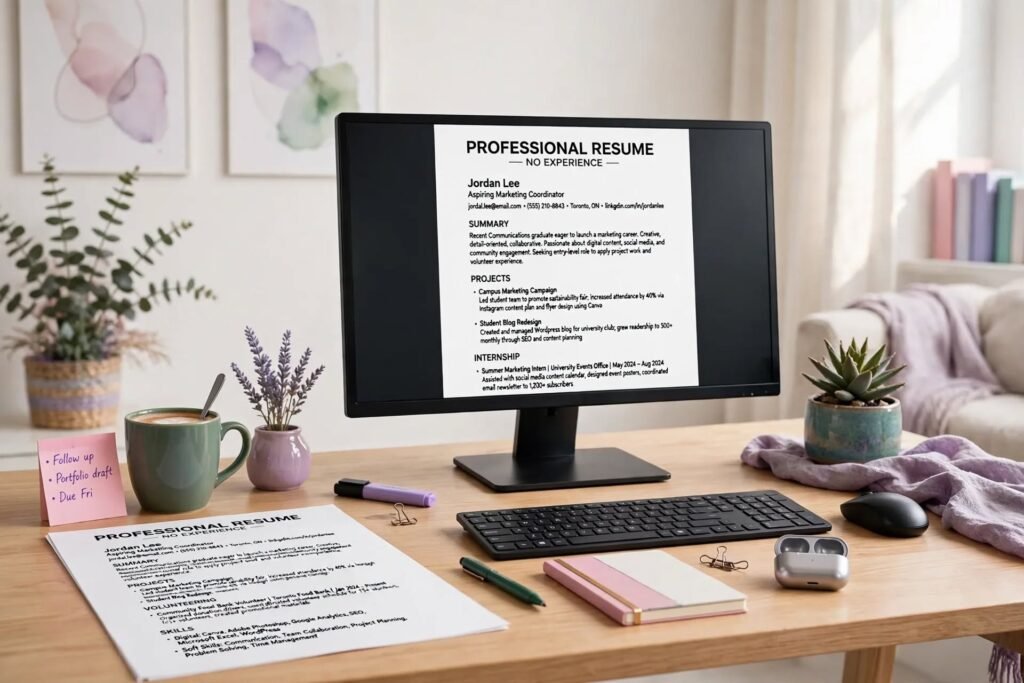
Every job advert seems to ask for experience, and you are applying because you need to get some. It is a frustrating loop, but it has a well-known way out. Employers hiring for entry-level roles do not expect a long work history. They look for signs that you are reliable, can learn quickly and have already done useful things, even if nobody paid you for them.
This guide shows how to build a resume from what you actually have: education, projects, volunteering, skills and responsibilities. It includes example lines, a sample layout and the mistakes that weaken first-time resumes. Wording is general advice, and you should adapt it to your own situation and the job you want.
- Experience is wider than paid work: School projects, volunteering, clubs, family responsibilities, freelance jobs and self-study can all show the skills an employer wants.
- Lead with your strongest section: Put education or projects first when they are more relevant than your work history, and keep the resume to one page.
- Match the job advert: Read the posting, pick the skills and keywords that apply to you honestly, and show them with short, specific examples.
- Never invent anything: Everything on the resume must be true and checkable, because exaggeration can cost you an offer later.
In this guide
Step 1: Choose the right structure
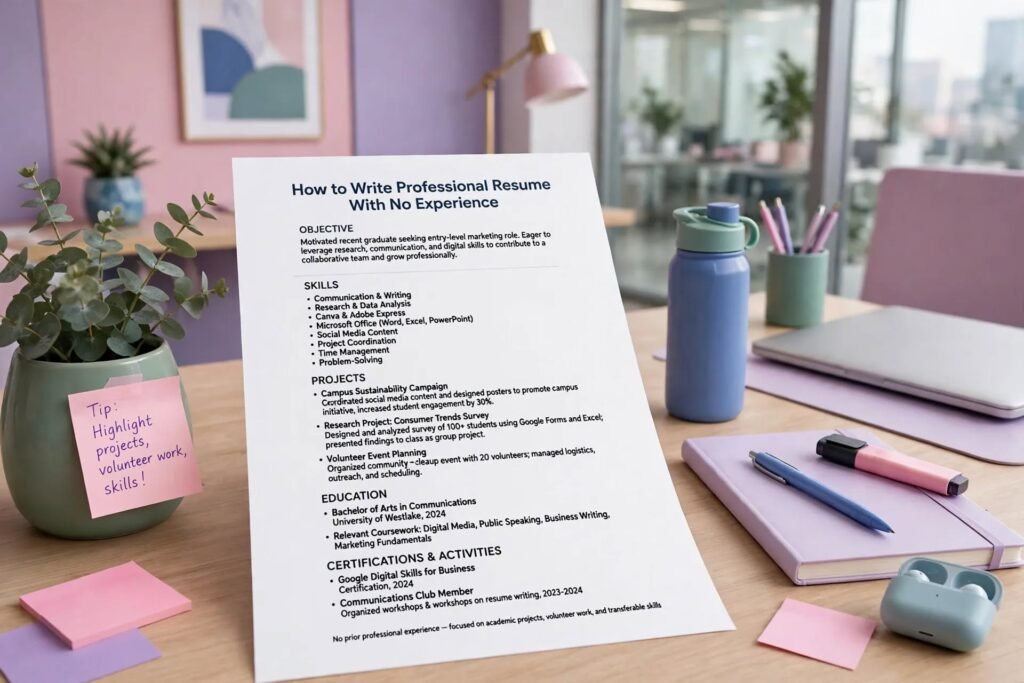
For a first resume, a simple order works best. Keep it to a single page, with a clear font and plenty of white space.
| Order | Section | What to include |
|---|---|---|
| 1 | Name and contact | Name, email, phone, city, and a profile link if it is professional |
| 2 | Summary | Two or three lines about who you are, what you offer and the role you want |
| 3 | Education | School or college, qualification, dates, relevant courses and results if strong |
| 4 | Projects | Two or three pieces of work that show skills the job needs |
| 5 | Experience | Volunteering, part-time or informal work, clubs and leadership |
| 6 | Skills | Tools, languages and abilities that match the job advert |
| 7 | Certificates | Short courses and training, with the provider and year |
Use a professional email address, such as your name, and check that your phone number and links work. Learn how to lay the document out cleanly in our guide to formatting a resume in Word, and use our Resume writing course for a step-by-step walk-through.
Step 2: Write a short, honest summary
A summary is a few lines at the top that tell the reader why to keep reading. Avoid empty phrases such as “hard-working team player”, which every resume contains. Instead name your field, one or two real strengths and what you want.
Recent business graduate with strong spreadsheet and presentation skills, gained through coursework and a student society treasurer role. Looking for an entry-level administrative position where accuracy and organisation matter.
If you are changing careers or returning to work, say so in a clear sentence. Keep the summary under 50 words.
Step 3: Make education work harder
When you have little work history, education is your main evidence. Include the name of your institution, your qualification and the dates. Add details that matter to the job: relevant courses, a final project, a strong grade if you are proud of it, or awards. If you are still studying, write the expected date, for example “Expected June 2027”.
Students can list group projects with a clear role, such as “Led a four-person team to design and present a market survey of 120 responses”. If you have no numbers, describe the result instead, for example “Presented findings to the class and received the top mark for the unit”. Include only figures that are true.
Step 4: Turn projects and activities into experience
Experience is anything that shows you doing real work. Look through your life for examples.
- Volunteering: Helping at a food bank, a school event or a community group shows reliability, teamwork and initiative, and many employers value it.
- Clubs and leadership: Running a society, captaining a team or organising an event proves that you can plan, communicate and handle responsibility.
- Freelance or informal work: Tutoring, babysitting, helping in a family shop or selling items online all involve customers, money and deadlines.
- Personal and course projects: A website you built, a video channel you run or a report that you wrote shows initiative and practical skills.
- Self-study: Online courses and certificates show that you can learn independently, especially when you apply the knowledge to a real project.
Step 5: Write strong bullet points
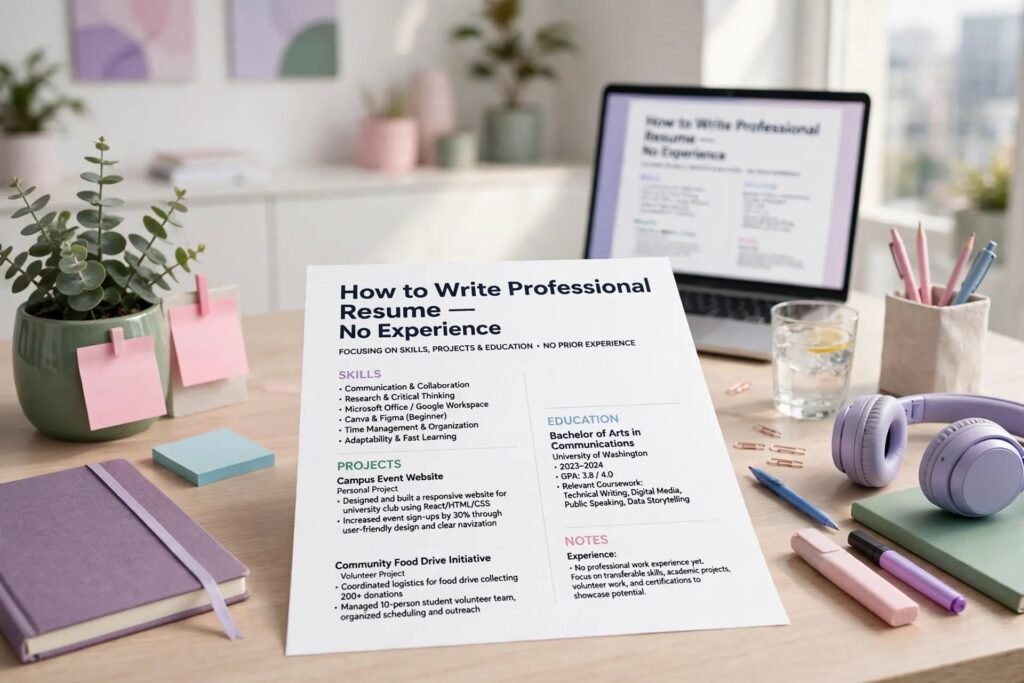
Each bullet should start with an action verb and say what you did and what came out of it. Compare weak and strong versions.
| Weak bullet | Stronger bullet |
|---|---|
| Responsible for helping customers | Helped an average of 30 customers a day with questions, payments and returns at a family shop |
| Good at social media | Grew a club’s Instagram page from 80 to 300 followers over one term by posting twice a week |
| Worked on a team project | Coordinated a four-person team to deliver a 12-slide presentation two days before the deadline |
| Know Excel | Built a budget spreadsheet with formulas and charts to track the society’s monthly spending |
Use only numbers that you can explain if asked in an interview. If you cannot measure something, describe its scale, such as “for a team of eight” or “over six months”. For more on turning tasks into results, try our free Word Counter to keep bullets short, and the Readability Score Checker to simplify long sentences.
Step 6: Choose skills with care
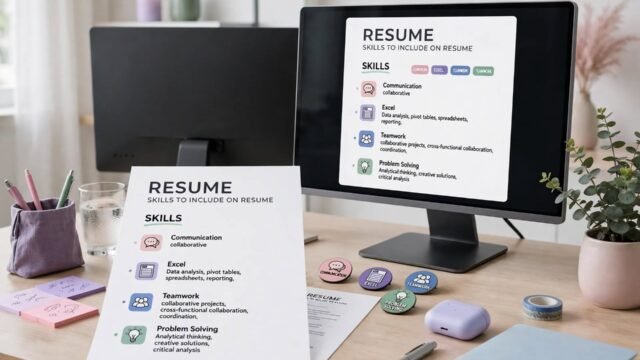
List skills that match the advert and that you can demonstrate. Split them into groups so that they are easy to scan.
- Technical skills: Software, tools and platforms you have used, such as Word, Excel, Google Workspace, a design tool or a programming language.
- Practical skills: Customer service, cash handling, scheduling, research or data entry.
- Languages: Name each language and your level, using a clear scale such as basic, conversational or fluent.
- Soft skills in context: Instead of listing communication or teamwork as words, show them through a bullet that proves the skill.
Our free Excel course is one way to add a skill that appears in many entry-level job adverts, and you can practise typing with the Online Typing Speed Test so that you can state a real speed.
Step 7: Tailor, proofread and send
Read the advert and underline the main requirements. Move the matching items higher on your page and use the employer’s own words where they are accurate. Do this for each application, because a general resume is weaker than a tailored one. Then proofread carefully. Spelling errors are common in first resumes and they stand out. Read the document aloud, ask a friend to review it and check dates, names and contact details.
When you send it, follow the employer’s instructions about the file type and file name, and use a short, polite email or cover letter. Our free Job Application Letter Builder and Professional Email Generator can help with the message that goes with it.
Mistakes to avoid
- Padding the page: A long list of irrelevant tasks makes the strong parts harder to find, so keep only what supports the application.
- Using a photo or personal details by default: Customs differ by country, and details such as age or marital status are not wanted in many places, so follow local norms.
- Writing in long paragraphs: Short bullets are easier to scan, since many readers give a resume only a quick first look.
- Leaving gaps unexplained: If you have a break for study, family or health, a short, neutral line is better than silence.
- Lying or exaggerating: False claims can be discovered during checks or at work, and they damage trust far more than a short resume does.
Questions
What do I put on a resume if I have no work experience?
Focus on education, projects, volunteering, clubs, certificates and skills that fit the job. Describe what you did and what resulted, using specific details. These show the same qualities that employers look for in paid work, such as reliability, learning and teamwork.
How long should a resume with no experience be?
One page is the standard for a first resume in many countries. A short, focused page is easier to read than a long one with filler. If you are applying where longer CVs are the norm, follow local custom and keep every line relevant.
Should I include a cover letter?
A short, tailored cover letter helps when you have little experience, because it lets you explain your motivation and connect your background to the job. Keep it to a few paragraphs and make it specific to the employer. Follow the application instructions, and if a cover letter is optional, writing one still shows effort.
Is it okay to include school and volunteer work?
Yes. For a first job these are often the best evidence you have. Describe your role, what you did and any result, in the same way as for a paid job, and be honest about hours and responsibilities.

 Careers